BMS Validation Testing Systems for Reliable Battery Performance
A practical guide to validating battery management systems for safety, accuracy, reliability, and real-world performance.

Introduction
Modern batteries are used in electric vehicles, energy storage systems, industrial equipment, medical devices, aircraft, and portable electronics. As battery technology becomes more advanced, the Battery Management System (BMS) has become an essential part of protecting and controlling the battery.
A BMS monitors important battery conditions such as cell voltage, current, temperature, state of charge, and other operating parameters. Because incorrect BMS behavior can affect battery performance and safety, thorough testing is required before a system is released.
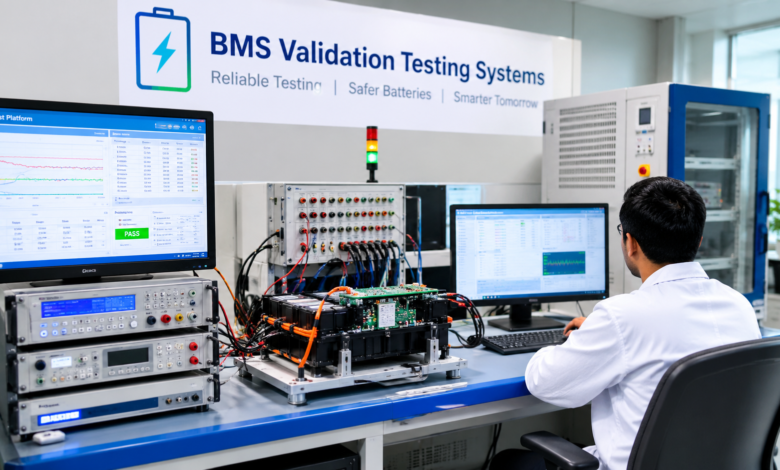
BMS Validation Testing Systems provide an organized environment for checking whether a BMS behaves correctly under normal operating conditions as well as unusual and fault conditions. Modern testing approaches can combine battery simulation, automated test sequences, hardware-in-the-loop testing, communication testing, and detailed data analysis.
ISO documentation specifically recognizes verification and validation as important parts of functional-safety development for road-vehicle systems, while ISO/TR 9968:2023 discusses the application of ISO 26262 methods to rechargeable energy storage systems that include BMS components.
What Are BMS Validation Testing Systems?
BMS Validation Testing Systems are hardware and software platforms designed to evaluate the behavior of a battery management system.
Instead of relying only on a physical battery pack, engineers can use controlled test equipment to reproduce different electrical and environmental conditions. This makes it possible to examine how the BMS responds to changing voltage, current, temperature, communication signals, and simulated faults.
A complete testing setup may include:
- Battery cell and pack simulators
- Programmable power supplies
- Electronic loads
- Measurement equipment
- Temperature and sensor simulation
- Communication interfaces
- Test automation software
- Data acquisition systems
- Hardware-in-the-loop simulation
- Fault-injection capabilities
The exact configuration depends on the battery architecture, BMS design, application, voltage range, communication protocols, and required safety objectives.
Why BMS Validation Is Important
Battery systems can contain many individual cells connected into modules and packs. The BMS must process information from these components and make appropriate decisions.
Testing helps engineers determine whether the BMS correctly responds to expected operating conditions and abnormal situations.
For example, validation can examine whether the BMS correctly detects:
- Excessive cell voltage
- Low cell voltage
- Excessive charging current
- Excessive discharge current
- High or low temperatures
- Sensor problems
- Communication errors
- Cell imbalance
- Other defined system faults
A testing system can reproduce these conditions in a controlled environment before the BMS is installed in a complete vehicle or energy-storage product.
This approach can reduce the need for repeated physical battery experiments while making test cases more repeatable.
Key Components of a BMS Testing System
Battery Simulation
Battery simulation is one of the most important elements of advanced BMS testing.
A simulator can reproduce individual cell voltages and battery operating conditions without requiring engineers to use a complete physical battery for every test. High-precision cell emulation can also help test individual channels and identify problems in monitoring circuits.
NI’s documented BMS testing approach describes cell emulation, sensor simulation, ECU communication, and fault insertion as important capabilities for BMS hardware-in-the-loop testing.
Hardware-in-the-Loop Testing
Hardware-in-the-loop, commonly called HIL testing, connects the actual BMS hardware to a real-time simulated battery environment.
The BMS operates as it would in an actual product, while the testing platform generates controlled battery conditions.
HIL testing is particularly useful because engineers can create repeatable scenarios that may be difficult, expensive, or unsafe to reproduce repeatedly with a real battery pack.
Documented industry applications have used HIL environments to test BMS firmware, battery chemistries, sensor behavior, communication, and fault scenarios.
Important BMS Validation Tests
Voltage Monitoring Tests
Cell voltage monitoring is a fundamental BMS function. Validation testing checks whether measured values correspond correctly to simulated or measured conditions.
Engineers can also test conditions where one cell differs significantly from the others.
Current Measurement Tests
Current measurement affects functions such as protection, charging control, and battery-state calculations.
Testing can introduce different current levels and transitions to determine whether the BMS responds according to its defined requirements.
Temperature Monitoring
Temperature sensors provide important information for battery protection and operating limits.
A validation system can simulate different sensor readings and verify that the BMS responds appropriately when temperature conditions move outside specified limits.
Cell Balancing Tests
Battery packs can develop differences between individual cells. Cell-balancing functionality is therefore an important area for validation.
Testing can introduce controlled differences between simulated cells and verify that the BMS identifies and manages the imbalance according to its design requirements.
Fault-Injection Testing
Fault injection allows engineers to deliberately introduce defined abnormal conditions.
Examples include simulated sensor faults, communication problems, abnormal voltage conditions, and other faults relevant to the BMS architecture.
This is valuable because simply testing normal operation does not demonstrate how a system behaves when something goes wrong.
Software and Communication Validation
A modern BMS is not only a collection of electronic circuits. It also contains embedded software responsible for calculations, monitoring, protection logic, diagnostics, and communication.
Testing therefore needs to examine both hardware and software behavior.
Model-based development environments can support requirements management, test management, coverage analysis, software-in-the-loop, processor-in-the-loop, closed-loop testing, and HIL validation.
Communication testing can also verify whether the BMS exchanges information correctly with other controllers and systems.
Depending on the application, engineers may need to validate message timing, signal values, diagnostic information, and responses to communication faults.
Functional Safety and Standards
Safety requirements are particularly important when a BMS is used in automotive and other safety-related applications.
ISO 26262 includes system-level development activities such as technical safety requirements, system architecture, integration testing, and safety validation for applicable road-vehicle electrical and electronic systems.
ISO/TR 9968:2023 provides an informative framework for applying ISO 26262 methodology to rechargeable energy storage systems in new-energy road vehicles and specifically includes BMS within the broader energy-storage system context.
IEC 61508 is another important functional-safety framework for electrical, electronic, and programmable electronic safety-related systems. Its requirements cover areas including safety lifecycle activities and safety validation.
The applicable standard should always be selected according to the product, industry, jurisdiction, and safety requirements rather than assuming that one standard applies to every BMS.
Benefits of Automated BMS Validation
Automation can make large BMS test programs more consistent.
A well-designed automated system can execute repeatable test sequences, record measurements, compare results against defined requirements, and generate reports.
Important benefits can include:
- Repeatable test conditions
- Faster execution of large test suites
- Improved test coverage
- Automated data collection
- Easier regression testing
- Better traceability
- Reduced manual testing effort
- More consistent documentation
For software updates, automated regression testing can be especially useful. When a change is introduced into BMS firmware, previously validated functions can be tested again to identify unexpected effects.
Choosing BMS Validation Testing Systems
Selecting the right testing platform requires more than comparing individual instruments.
Engineers should first define the BMS architecture and testing objectives. Important considerations include the number of cells, voltage range, current range, measurement accuracy, communication interfaces, response time, safety requirements, automation needs, and required fault scenarios.
Scalability is also important. A laboratory may initially test a small number of channels but later need to validate larger battery configurations.
The test platform should therefore provide appropriate measurement accuracy, flexible simulation capabilities, reliable data acquisition, and software that can support repeatable automated testing.
The Role of Data and Test Reports
Testing produces large amounts of information. A useful validation system should make that data easy to analyze and document.
Engineers may need to compare expected and measured values, identify failed test cases, review fault responses, and maintain evidence that requirements have been tested.
Clear reporting is particularly useful during development because it allows teams to identify problems early and track whether corrective changes have resolved them.
Future of BMS Validation Testing
Battery technology continues to develop, and validation methods are evolving alongside it.
More sophisticated real-time simulation, automated testing, model-based development, and scalable HIL platforms can help engineers evaluate increasingly complex battery systems.
As battery packs become larger and software becomes more important, validation will increasingly involve both physical hardware and virtual test environments.
The goal is not simply to run more tests. Effective validation means creating meaningful test cases that connect requirements with measurable results.
Conclusion
BMS Validation Testing Systems play an important role in developing dependable battery-powered products. By combining battery simulation, measurement equipment, automation, fault injection, software testing, and HIL technology, engineers can examine BMS behavior under a wide range of controlled conditions.
Standards such as ISO 26262 and IEC 61508 provide relevant functional-safety frameworks for applicable systems, while modern HIL approaches demonstrate how real BMS hardware can be tested against simulated battery and fault conditions.
A carefully designed validation strategy can improve traceability, repeatability, test coverage, and confidence in BMS performance before deployment.
Frequently Asked Questions
What is a BMS validation testing system?
It is a combination of hardware and software used to verify and validate the behavior of a Battery Management System under normal and defined abnormal operating conditions.
Why is HIL testing useful for BMS validation?
HIL testing connects real BMS hardware to a real-time simulated environment. This allows engineers to reproduce controlled battery conditions and fault scenarios without depending entirely on a physical battery pack.
What functions should a BMS be tested for?
Typical validation areas include voltage measurement, current measurement, temperature monitoring, cell balancing, diagnostics, communication, protection logic, and defined fault responses.
Can BMS testing be automated?
Yes. Automated systems can execute test sequences, collect measurements, compare results with requirements, and support regression testing.
Which standards are relevant to BMS validation?
The appropriate standard depends on the application. ISO 26262 is relevant to functional safety in applicable road-vehicle E/E systems, while IEC 61508 provides a general functional-safety framework for electrical, electronic, and programmable electronic safety-related systems.
What is fault-injection testing?
Fault-injection testing deliberately introduces defined abnormal inputs or conditions so engineers can observe whether the BMS detects and handles them according to its requirements.
Why is battery simulation important?
Battery simulation allows engineers to reproduce controlled cell and pack conditions, making it easier to conduct repeatable tests and investigate BMS behavior.
What makes a good BMS validation platform?
A suitable platform should match the BMS architecture and testing requirements while providing appropriate accuracy, scalability, automation, communication support, data collection, and fault-testing capabilities.